Rearmament via Algorithm: The New Dimension of EU Border Surveillance
In the Era of Techno-Authoritarianism: Why We Need to Talk About AI and Digital Surveillance
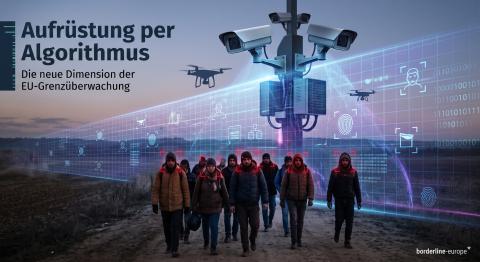
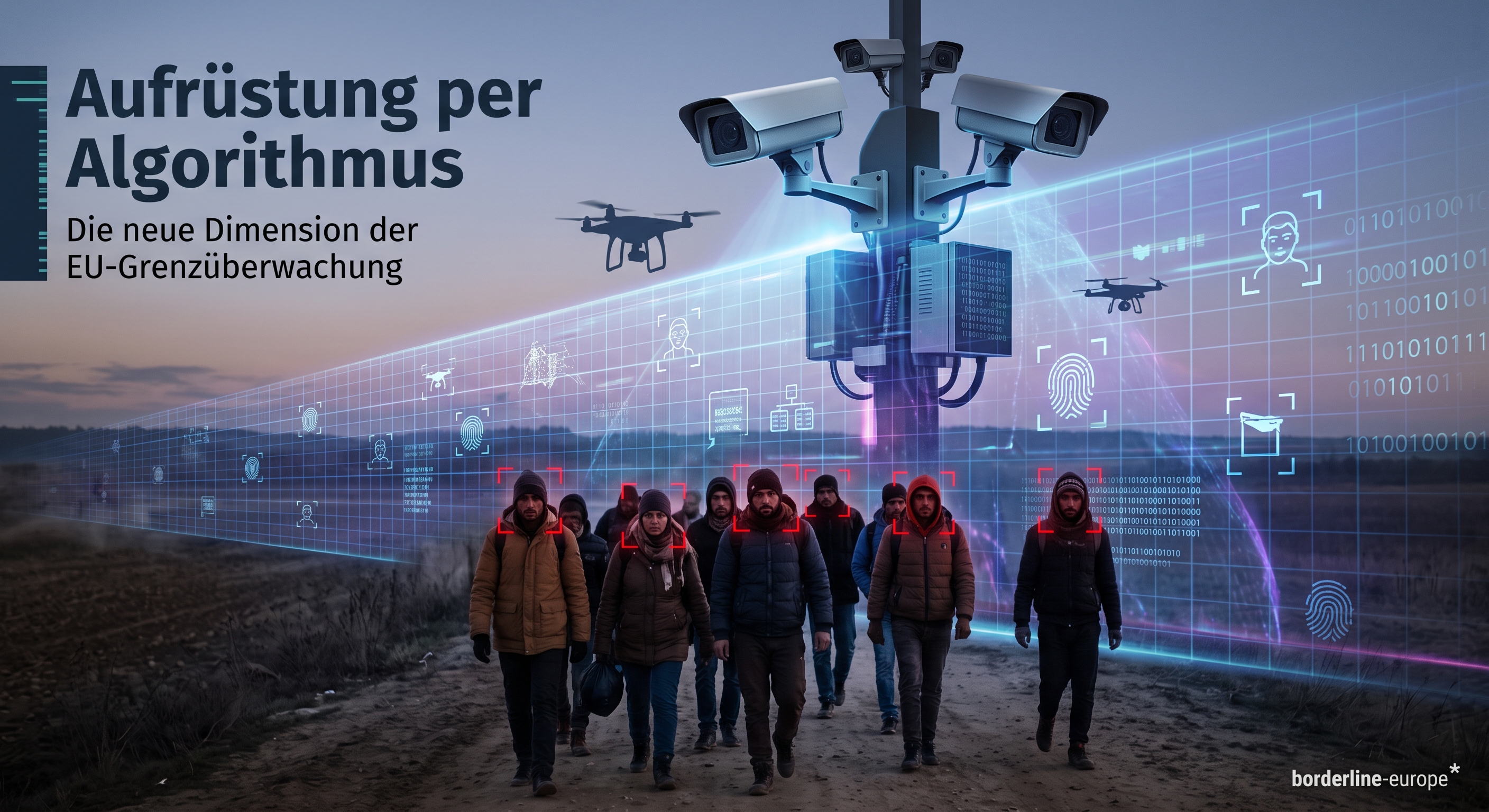
The use of AI is far-reaching and extends into all areas of life. What is rarely discussed is how AI is used for internal state surveillance and border control. Technological advancements now offer such extensive and advanced capacities that mass surveillance and data analysis are no longer a challenge. Instead of barbed wire, border police, and high fences, measures are being prepared in the shadows to closely monitor all activities. Large datasets, algorithms, biometrics, drones, AI, and cameras are now the new basic equipment used to turn away people in need at the borders or prevent them from arriving in the first place.
Under the guise of national "security," national security authorities and border protection agencies like Frontex operate on the fringes of legality and beyond. This not only affects the people at the borders but also our own future and the risk of entering an increasingly technology-dependent downward spiral where the idea of an all-seeing "Big Brother" is no longer fiction. The problem? These systems often operate in secret and frequently without any public transparency. They are tested and deployed on groups who know nothing about them and do not understand the technology, which categorically precludes consent before clear fundamental rights protection mechanisms can even intervene. Thus, the actors shift their mandated responsibility onto data-driven algorithms and machines, making human rights violations—such as illegal pushbacks—even harder to document for the public.
As borderline-europe, we have been observing the developments at the EU's external borders on the ground in Berlin and Palermo, Italy, for many years, effectively advocating to draw public attention to the human rights-violating treatment at the EU borders. To effectively critique the European border regime today, we must also look at where technology is used as a tool of exclusion.
Our Article Series: "Rearmament via Algorithm"
In the coming weeks, our multi-part investigative series will shed light on the intersection of artificial intelligence, surveillance technology, border policy, migration, and human rights:
- Part 1: The Transparent External Border – Drones, sensors & how surveillance makes illegal pushbacks invisible.
- Part 2: Eurodac & Measuring the Body – Biometric data collection and data kraken at the borders.
- Part 3: Exporting Borders via Code – How the EU is shifting digital surveillance to third countries (Tunisia, Niger, etc.).
- Part 4: The EU AI Act – The promise of fundamental rights protection vs. free passes for security agencies.
- Part 5: The Business of Fear – The security industry, EU funding, and the border AI business.
- Part 6: AI in the German/Italian Asylum Procedure – Voice analysis, mobile phone extraction, and the flaws of algorithms at the BAMF.
- Part 7: The Automated Internal Border – Predictive policing, automated controls & racial profiling in Germany.
- Part 8: Conclusion and Future Prospects – How civil society is fighting back with open-source tools and countersurveillance.
Join us starting this week, every Thursday on our website and on our social media channels. Follow the posts, share the analyses, and help us shine a light into the digital shadows of European border policy.
Part 1. Over Land, Sea, and Sky: How Drones Are Pushing the New Borders
Instead of investing in physical blockades, more focus has been placed on preemptive measures and increasing the blurriness of the EU’s external borders. What implications does this hold for the future, and are we getting closer to becoming a techno-oriented surveillance state?
August 25, 2026
Author: Christopher Chen
Introduction
To kick off this multi-part series, some thoughts were put into its structure. In a topic as vast as this, which includes migration policies, digital surveillance, human rights violations, and so on, it is difficult to even find a starting point for tackling this behemoth of a subject that involves millions of human lives and enormous amounts of money spent on technology. However, the structure becomes quite clear if you think about it from an inside-in perspective. It would be most sensible to start from the perspective of the people involved: the refugees.
We follow their route as they arrive at the border, where, even before they set foot on land, the process of data collection and processing already begins because the borders have been shifted and extended far beyond what they are. After that, any conceivable form of personal data is taken and stored for future use by border agencies and the state, until we land in Germany, one of the leading European countries in digital surveillance and digital border control. There, we can look into the whole background and inner workings of these techno-geopolitical systems, where “national security” is used as a selling point, first to justify stronger state authority and, second, for tech companies to further capitalize, all under the guise and pretense of technological innovation and improvement.
Drones…, Drones…, Drones are Everywhere!
No matter where you start as a refugee trying to find a better life with better opportunities, you must choose a way of transport to reach your destination. Because the options are limited, the most popular methods usually involve crossing by sea or land. Recent years have shown that, instead of simply increasing traditional border controls, states and agencies have increasingly shifted their focus toward preemptive measures, technological surveillance, and the externalization of border control (Bundeszentrale für politische Bildung, 2025; Metcalfe et al., 2023). Usually, this involves the use of highly advanced, unmanned vehicles such as drones. Their technical capabilities have increased significantly over the last few years, especially in combination with advancements in AI technology, which can make them increasingly automated and independent.
According to Christian Kaiser, a German drone manufacturer interviewed by Deutsche Welle, forms of unit coordination, swarm formations, and autonomous operation can increasingly be controlled from command centers or automated through specific prompts (Deutsche Welle, n.d.). The forms and shapes are no longer limited by the technical boundaries that traditionally defined conventional drones.
Capabilities
Other than aerial surveillance platforms such as the Heron 1, unmanned aircraft are increasingly being used for border surveillance. Frontex, for example, has deployed unmanned aircraft to support border control and pre-frontier surveillance in the Eastern Mediterranean. These aircraft can carry thermal cameras and radar and transmit live video and other information to Frontex headquarters in real time (Bundeswehr, 2019; Frontex, 2022). Aquatic and disguised stationary models in the form of solar towers or rocks are also becoming more advanced and capable of collecting and processing data using AI (Heinrich-Böll-Stiftung, 2024).
This way, the reach of border patrol is already extending outward without officers physically being there, allowing them to be alerted preemptively. AI and data-driven systems are increasingly embedded within European border infrastructures, enabling the monitoring, identification, and prediction of migration movements (Bundeszentrale für politische Bildung, 2025; Metcalfe et al., 2023). Equipped with thermal cameras, facial recognition, and motion detection software, such systems can be used across large areas and with relatively little direct human presence, making them increasingly efficient tools for border surveillance.
This technological infrastructure can also facilitate practices such as pushbacks or the interception of people before they reach European territory, raising significant human-rights and legal concerns (Heinrich-Böll-Stiftung, 2024; Metcalfe et al., 2023). Under normal circumstances, states and vessels are legally obliged to provide assistance to persons in distress at sea under Article 98 of UNCLOS and the SOLAS Convention (International Maritime Organization [IMO], 1974; United Nations, 1982). The demand is thus not only for detecting and identifying refugees but increasingly also for intercepting them. Combining these capabilities with AI allows for real-time camera feeds, radar, and motion detection, laying the way for surveillance long before reaching any coast, beginning the moment people step onto a boat or take their first step.
Shifting Borders into No Man’s Land
With all these advances, borders take on a whole new dimension. No longer limited to land, sea, or sky, they now stretch everywhere, wherever states want them to—even into digital space. The development of “smart borders” increasingly combines surveillance technologies, data infrastructures, AI, and externalized forms of border control (Metcalfe et al., 2023).
All this surveillance will still not completely stop immigration, though, but instead can push refugees toward more dangerous routes and force them to take greater risks, endangering their lives. Migration and human-rights lawyer Petra Molnar has warned about the human-rights consequences of increasingly technological border control, while research on Europe’s smart borders similarly highlights the risks created by increasingly restrictive and technologically mediated migration controls (Deutsche Welle, n.d.; Metcalfe et al., 2023).
So then the question comes up: why does the EU do it? The answer is extremely multifaceted and will be further discussed in the following parts and, by the end, will hopefully provide a satisfactory, contextualized answer. But to start, one can think of it as a kind of “see no evil.” If refugees are intercepted before they reach EU territory, in the airspace or on the open seas, the chance of accessing the European asylum system becomes significantly reduced. This allows EU member states to externalize part of the responsibility for migration control because the legal and political responsibility becomes more difficult to attribute when interception takes place outside EU territory (Metcalfe et al., 2023).
Instead, responsibility is increasingly pushed onto third countries such as Libya, which receive European political and operational support for migration control. Recent reporting has documented growing European cooperation with actors in eastern Libya, while the United Nations has documented widespread and systematic human-rights violations against migrants, asylum seekers, and refugees in the country (Antoniadis et al., 2026; Office of the United Nations High Commissioner for Human Rights [OHCHR] & United Nations Support Mission in Libya [UNSMIL], 2026). In this way, European states can maintain their good image and “don’t get their hands dirty.”
Conclusion
Drones will become an increasingly popular tool for political purposes. Like in war, drones reign supreme for their intended purposes and will eventually and gradually take the “human” out of the equation. In this case, they reduce people to mere threat points on a screen and make them invisible to political powers, treating them disproportionately compared to other people.
In the second part, we will deal with what happens on the ground: how biometric face scans, facial recognition, and private data collection are used when arriving at the border.
References
Antoniadis, N., Lüdke, S., & Haidar, A. (2026, August 19). How Europe is bowing to a Libyan warlord on migration. DER SPIEGEL.
Bundeswehr. (2019, November 13). Die Drohne Heron 1 – lautlose Aufklärung aus der Luft. https://www.bundeswehr.de/de/ausruestung-technik-bundeswehr/luftsysteme-bundeswehr/drohne-heron-1
Bundeszentrale für politische Bildung. (2025, September 4). Artificial intelligence in migration management: Opportunities, challenges, and risks. https://www.bpb.de/themen/migration-integration/kurzdossiers/570380/artificial-intelligence-in-migration-management/
Deutsche Welle. (n.d.). How much can AI improve border control security?
Frontex. (2022, July 11). Frontex deploys unmanned aircraft to support Greece with border control. https://prd.frontex.europa.eu/wp-content/uploads/220711-frontex-deploys-unmanned-aircraft-to-support-greece-with-border-control.pdf
Heinrich-Böll-Stiftung. (2024, August 8). The hidden border security-industrial complex. https://us.boell.org/en/2024/08/08/hidden-border-security-industrial-complex
International Maritime Organization. (1974). International Convention for the Safety of Life at Sea (SOLAS), 1974. https://www.imo.org/
Metcalfe, P., Dencik, L., Chelioudakis, E., & van Eerd, B. (2023). Risking lives: Smart borders, private interests and AI policy in Europe. Data Justice Lab.
Office of the United Nations High Commissioner for Human Rights, & United Nations Support Mission in Libya. (2026). Business as usual: Human rights violations and abuses against migrants, asylum seekers and refugees in Libya. OHCHR.
United Nations. (1982). United Nations Convention on the Law of the Sea. https://www.un.org/depts/los/convention_agreements/texts/unclos/unclos_e.pdf