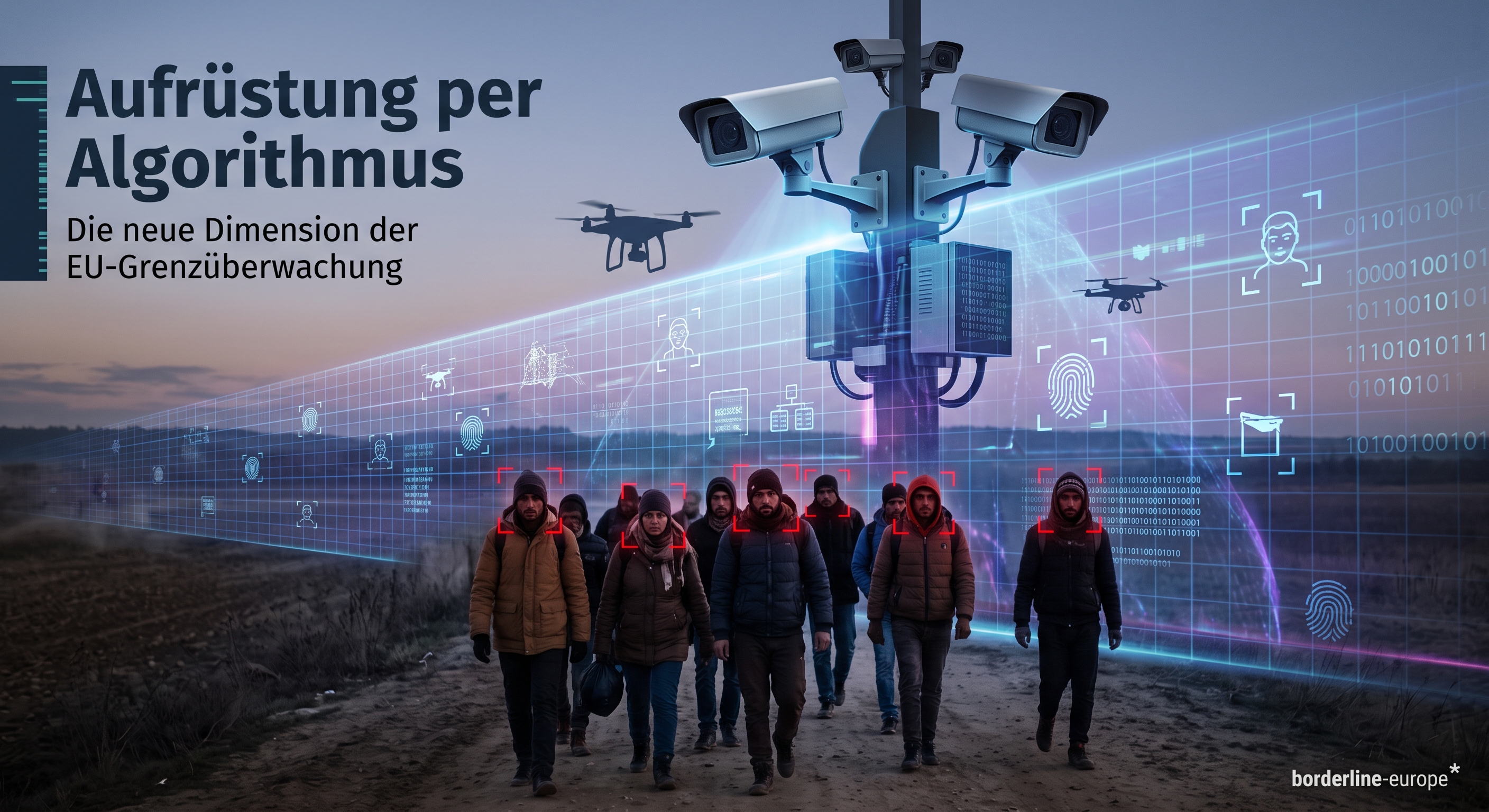
Rearmament via Algorithm: The New Dimension of EU Border Surveillance
In the Era of Techno-Authoritarianism: Why We Need to Talk About AI and Digital Surveillance
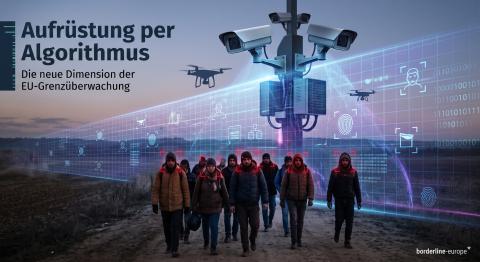
The use of AI is far-reaching and extends into all areas of life. What is rarely discussed is how AI is used for internal state surveillance and border control. Technological advancements now offer such extensive and advanced capacities that mass surveillance and data analysis are no longer a challenge. Instead of barbed wire, border police, and high fences, measures are being prepared in the shadows to closely monitor all activities. Large datasets, algorithms, biometrics, drones, AI, and cameras are now the new basic equipment used to turn away people in need at the borders or prevent them from arriving in the first place.
Under the guise of national "security," national security authorities and border protection agencies like Frontex operate on the fringes of legality and beyond. This not only affects the people at the borders but also our own future and the risk of entering an increasingly technology-dependent downward spiral where the idea of an all-seeing "Big Brother" is no longer fiction. The problem? These systems often operate in secret and frequently without any public transparency. They are tested and deployed on groups who know nothing about them and do not understand the technology, which categorically precludes consent before clear fundamental rights protection mechanisms can even intervene. Thus, the actors shift their mandated responsibility onto data-driven algorithms and machines, making human rights violations—such as illegal pushbacks—even harder to document for the public.
As borderline-europe, we have been observing the developments at the EU's external borders on the ground in Berlin and Palermo, Italy, for many years, effectively advocating to draw public attention to the human rights-violating treatment at the EU borders. To effectively critique the European border regime today, we must also look at where technology is used as a tool of exclusion.
Our Article Series: "Rearmament via Algorithm"
In the coming weeks, our multi-part investigative series will shed light on the intersection of artificial intelligence, surveillance technology, border policy, migration, and human rights:
- Part 1: The Transparent External Border – Drones, sensors & how surveillance makes illegal pushbacks invisible.
- Part 2: Eurodac & Measuring the Body – Biometric data collection and data kraken at the borders.
- Part 3: Exporting Borders via Code – How the EU is shifting digital surveillance to third countries (Tunisia, Niger, etc.).
- Part 4: The EU AI Act – The promise of fundamental rights protection vs. free passes for security agencies.
- Part 5: The Business of Fear – The security industry, EU funding, and the border AI business.
- Part 6: AI in the German/Italian Asylum Procedure – Voice analysis, mobile phone extraction, and the flaws of algorithms at the BAMF.
- Part 7: The Automated Internal Border – Predictive policing, automated controls & racial profiling in Germany.
- Part 8: Conclusion and Future Prospects – How civil society is fighting back with open-source tools and countersurveillance.
Join us starting this week, every Thursday on our website and on our social media channels. Follow the posts, share the analyses, and help us shine a light into the digital shadows of European border policy.
Part 1. Over Land, Sea, and Sky: How Drones Are Pushing the New Borders
Instead of investing in physical blockades, more focus has been placed on preemptive measures and increasing the blurriness of the EU’s external borders. What implications does this hold for the future, and are we getting closer to becoming a techno-oriented surveillance state?
August 25, 2026
Author: Christopher Chen
Introduction
To kick off this multi-part series, some thoughts were put into its structure. In a topic as vast as this, which includes migration policies, digital surveillance, human rights violations, and so on, it is difficult to even find a starting point for tackling this behemoth of a subject that involves millions of human lives and enormous amounts of money spent on technology. However, the structure becomes quite clear if you think about it from an inside-in perspective. It would be most sensible to start from the perspective of the people involved: the refugees.
We follow their route as they arrive at the border, where, even before they set foot on land, the process of data collection and processing already begins because the borders have been shifted and extended far beyond what they are. After that, any conceivable form of personal data is taken and stored for future use by border agencies and the state, until we land in Germany, one of the leading European countries in digital surveillance and digital border control. There, we can look into the whole background and inner workings of these techno-geopolitical systems, where “national security” is used as a selling point, first to justify stronger state authority and, second, for tech companies to further capitalize, all under the guise and pretense of technological innovation and improvement.
Drones…, Drones…, Drones are Everywhere!
No matter where you start as a refugee trying to find a better life with better opportunities, you must choose a way of transport to reach your destination. Because the options are limited, the most popular methods usually involve crossing by sea or land. Recent years have shown that, instead of simply increasing traditional border controls, states and agencies have increasingly shifted their focus toward preemptive measures, technological surveillance, and the externalization of border control (Bundeszentrale für politische Bildung, 2025; Metcalfe et al., 2023). Usually, this involves the use of highly advanced, unmanned vehicles such as drones. Their technical capabilities have increased significantly over the last few years, especially in combination with advancements in AI technology, which can make them increasingly automated and independent.
According to Christian Kaiser, a German drone manufacturer interviewed by Deutsche Welle, forms of unit coordination, swarm formations, and autonomous operation can increasingly be controlled from command centers or automated through specific prompts (Deutsche Welle, n.d.). The forms and shapes are no longer limited by the technical boundaries that traditionally defined conventional drones.
Capabilities
Other than aerial surveillance platforms such as the Heron 1, unmanned aircraft are increasingly being used for border surveillance. Frontex, for example, has deployed unmanned aircraft to support border control and pre-frontier surveillance in the Eastern Mediterranean. These aircraft can carry thermal cameras and radar and transmit live video and other information to Frontex headquarters in real time (Bundeswehr, 2019; Frontex, 2022). Aquatic and disguised stationary models in the form of solar towers or rocks are also becoming more advanced and capable of collecting and processing data using AI (Heinrich-Böll-Stiftung, 2024).
This way, the reach of border patrol is already extending outward without officers physically being there, allowing them to be alerted preemptively. AI and data-driven systems are increasingly embedded within European border infrastructures, enabling the monitoring, identification, and prediction of migration movements (Bundeszentrale für politische Bildung, 2025; Metcalfe et al., 2023). Equipped with thermal cameras, facial recognition, and motion detection software, such systems can be used across large areas and with relatively little direct human presence, making them increasingly efficient tools for border surveillance.
This technological infrastructure can also facilitate practices such as pushbacks or the interception of people before they reach European territory, raising significant human-rights and legal concerns (Heinrich-Böll-Stiftung, 2024; Metcalfe et al., 2023). Under normal circumstances, states and vessels are legally obliged to provide assistance to persons in distress at sea under Article 98 of UNCLOS and the SOLAS Convention (International Maritime Organization [IMO], 1974; United Nations, 1982). The demand is thus not only for detecting and identifying refugees but increasingly also for intercepting them. Combining these capabilities with AI allows for real-time camera feeds, radar, and motion detection, laying the way for surveillance long before reaching any coast, beginning the moment people step onto a boat or take their first step.
Shifting Borders into No Man’s Land
With all these advances, borders take on a whole new dimension. No longer limited to land, sea, or sky, they now stretch everywhere, wherever states want them to—even into digital space. The development of “smart borders” increasingly combines surveillance technologies, data infrastructures, AI, and externalized forms of border control (Metcalfe et al., 2023).
All this surveillance will still not completely stop immigration, though, but instead can push refugees toward more dangerous routes and force them to take greater risks, endangering their lives. Migration and human-rights lawyer Petra Molnar has warned about the human-rights consequences of increasingly technological border control, while research on Europe’s smart borders similarly highlights the risks created by increasingly restrictive and technologically mediated migration controls (Deutsche Welle, n.d.; Metcalfe et al., 2023).
So then the question comes up: why does the EU do it? The answer is extremely multifaceted and will be further discussed in the following parts and, by the end, will hopefully provide a satisfactory, contextualized answer. But to start, one can think of it as a kind of “see no evil.” If refugees are intercepted before they reach EU territory, in the airspace or on the open seas, the chance of accessing the European asylum system becomes significantly reduced. This allows EU member states to externalize part of the responsibility for migration control because the legal and political responsibility becomes more difficult to attribute when interception takes place outside EU territory (Metcalfe et al., 2023).
Instead, responsibility is increasingly pushed onto third countries such as Libya, which receive European political and operational support for migration control. Recent reporting has documented growing European cooperation with actors in eastern Libya, while the United Nations has documented widespread and systematic human-rights violations against migrants, asylum seekers, and refugees in the country (Antoniadis et al., 2026; Office of the United Nations High Commissioner for Human Rights [OHCHR] & United Nations Support Mission in Libya [UNSMIL], 2026). In this way, European states can maintain their good image and “don’t get their hands dirty.”
Conclusion
Drones will become an increasingly popular tool for political purposes. Like in war, drones reign supreme for their intended purposes and will eventually and gradually take the “human” out of the equation. In this case, they reduce people to mere threat points on a screen and make them invisible to political powers, treating them disproportionately compared to other people.
In the second part, we will deal with what happens on the ground: how biometric face scans, facial recognition, and private data collection are used when arriving at the border.
References
Antoniadis, N., Lüdke, S., & Haidar, A. (2026, August 19). How Europe is bowing to a Libyan warlord on migration. DER SPIEGEL.
Bundeswehr. (2019, November 13). Die Drohne Heron 1 – lautlose Aufklärung aus der Luft. https://www.bundeswehr.de/de/ausruestung-technik-bundeswehr/luftsysteme-bundeswehr/drohne-heron-1
Bundeszentrale für politische Bildung. (2025, September 4). Artificial intelligence in migration management: Opportunities, challenges, and risks. https://www.bpb.de/themen/migration-integration/kurzdossiers/570380/artificial-intelligence-in-migration-management/
Deutsche Welle. (n.d.). How much can AI improve border control security?
Frontex. (2022, July 11). Frontex deploys unmanned aircraft to support Greece with border control. https://prd.frontex.europa.eu/wp-content/uploads/220711-frontex-deploys-unmanned-aircraft-to-support-greece-with-border-control.pdf
Heinrich-Böll-Stiftung. (2024, August 8). The hidden border security-industrial complex. https://us.boell.org/en/2024/08/08/hidden-border-security-industrial-complex
International Maritime Organization. (1974). International Convention for the Safety of Life at Sea (SOLAS), 1974. https://www.imo.org/
Metcalfe, P., Dencik, L., Chelioudakis, E., & van Eerd, B. (2023). Risking lives: Smart borders, private interests and AI policy in Europe. Data Justice Lab.
Office of the United Nations High Commissioner for Human Rights, & United Nations Support Mission in Libya. (2026). Business as usual: Human rights violations and abuses against migrants, asylum seekers and refugees in Libya. OHCHR.
United Nations. (1982). United Nations Convention on the Law of the Sea. https://www.un.org/depts/los/convention_agreements/texts/unclos/unclos_e.pdf
Part 2: You Are the Passport — How Biometric Scans Are Used at the Border as a New Form of Profiling
Long gone are the days when the collection and processing of personal data were conducted solely by humans. Technological advancements now allow the body itself to become a landscape of identification markers. Will this digitalization create an ever-growing dependence on data over human observation?
September 08, 2026
Author: Christopher Chen
Introduction
We continue to follow the path of the refugees in Part 2 and arrive at the borders of a European country. The moment we set foot on land, suspicion is already forming in the mind of the border guard who sees us. At the same time, long-range thermal-vision cameras and motion-detection sensors, as well as smart tools that enhance detection, are already doing their work, assessing your data and immediately placing it into private or governmental databases for further processing.
After surviving for multiple days at sea, without proper food, water, or safety, while countless drones have been flying above your head and people have already died along the way, you are immediately considered a potential foreign threat and treated accordingly, with suspicion as the starting point. To address these suspicions, the EU increasingly employs comprehensive biometric registration and categorization of travelers and refugees, raising significant concerns about privacy, consent, and discrimination (Kieran et al., 2019).
From Toe to Head, from Finger to Eye, from the Phone to the Server
The EU has invested millions upon millions in the securitization and digitalization of its borders over the years, with the post-9/11 period marking an important acceleration in this development (Kieran et al., 2019). Every possibility needs to be accounted for in the most time- and cost-efficient way. This means an increased reliance on border-control technology to process vast amounts of personal information and meet the growing demand to know every detail about the potential threats and risks that a person or group may pose.
The processing behind this is just as complex as the political negotiations behind the scenes to further increase the amount of information that can be gathered while remaining within the boundaries of international and European law. The process usually starts with the collection of several biometric markers, such as fingerprints, facial images, DNA samples, iris scans, and other personal data, as well as information stored on carried electronic devices. This alone is already a concern for privacy protection, as individuals can effectively be forced to expose highly personal aspects of themselves based on a generalized or unsubstantiated suspicion. This automatically sets them apart from regular EU citizens and creates a high possibility of profiling and discrimination.
Often, these assessments are imposed on them, leaving the role of actual consent with very little significance. Shelter, food, and daily accommodations may be tied to obligatory registration or scanning procedures, while refugees may not fully understand what is technically being done to them because of insufficient translations or a lack of understandable explanations about the technology involved. Consent in the classical legal sense is therefore difficult to establish (Kieran et al., 2019).
Technical Capabilities
Examples include Greece’s Iperion, an automated digital surveillance system, and Kentauros, a surveillance system deployed inside refugee facilities, enabling surveillance and technical coordination with the use of artificial-intelligence behavioral analytics. Other examples include smart portable devices enabling the use of facial recognition and automated fingerprint identification during police stops, as well as SARI (Sistema Automatico Riconoscimento Immagini), an automated facial-image recognition system used by Italian police (Giannini, 2024).
Particularly within the ecosystem of a processing facility, this kind of surveillance and monitoring can effectively transform accommodation centers into high-security environments. More broadly, the increasing use of biometric and AI-based systems demonstrates how border control is becoming increasingly data-driven and technologically mediated (Kieran et al., 2019; Metcalfe et al., 2023).
Databases
All these measures are technically possible because of large databases and data infrastructures that store and process information for interoperable use. Important European databases and systems include SIS II (Schengen Information System II), VIS (Visa Information System), EURODAC (European Asylum Dactyloscopy Database), ETIAS, EES, and ECRIS-TCN, which collectively play important roles in European travel, migration, asylum, and law-enforcement processes.
With the help of automated biometric verification, authorities can use stored data to verify a person's identity by searching and matching identifiers such as name, date of birth, fingerprints, facial characteristics, and other biometric information across interconnected systems. This can include information about routes of travel, previous applications, and legal or administrative status, increasingly creating a digital identity that can follow a person across different systems and borders (Kieran et al., 2019; Metcalfe et al., 2023).
Internalization and Inconsistencies
This development shows that borders not only extend outward, as discussed in the previous text, beyond where they physically exist, but are also increasingly projected into people themselves, effectively making individuals carry aspects of the border with them wherever they go. Every aspect of the body can be systematically and mechanically operationalized to create a digital identification, reducing a person to a set of data points and risk calculations (Metcalfe et al., 2023).
To add to this, automated systems can produce errors and biases in their assessments, potentially contributing to wrongful identification, extended data retention, detention, or even deportation. The lack of consistent legal frameworks governing how algorithmic systems are translated into government policy can leave room for mistakes and make accountability difficult when individuals are harmed (Kieran et al., 2019).
Furthermore, research by Buolamwini and Gebru (2018) demonstrated significant demographic disparities in the performance of commercial facial-analysis systems. Their study found that the datasets they examined were disproportionately composed of lighter-skinned subjects and that darker-skinned women were the most frequently misclassified group. These findings demonstrate how biased or unrepresentative training and benchmark datasets can contribute to unequal performance across demographic groups (Buolamwini & Gebru, 2018).
Correcting such problems requires transparency, accountability, and the ability to scrutinize how these systems are designed and trained. This becomes particularly difficult when the underlying technologies are developed or operated by private companies and protected by complex legal and commercial frameworks, making it unclear who is ultimately responsible when something goes wrong (Metcalfe et al., 2023).
Conclusion
Ultimately, these technologies are increasingly being tested and deployed in a complex and sometimes unclear legal sphere, often involving people who cannot fully or freely consent to the collection and processing of their data. There is no straightforward way for individuals to challenge an AI-based assessment when it is unclear where suspicion begins and where it ends. The power dynamic is therefore shifted heavily toward one side, leaving the other with limited options to challenge the system and tip the balance, creating a potentially perpetual cycle of one-sided control.
As the technology develops further through the continuous accumulation of data, the possibility that a total techno-surveillance state could one day be just around the corner becomes an increasingly daunting reality.
References
Buolamwini, J., & Gebru, T. (2018). Gender shades: Intersectional accuracy disparities in commercial gender classification. Proceedings of the 1st Conference on Fairness, Accountability and Transparency, 81, 77–91. https://proceedings.mlr.press/v81/buolamwini18a.html
Giannini, A. (2024, October 3). Law enforcement and facial recognition technologies in Italy – An activist’s update. Digital Freedom Fund. https://digitalfreedomfund.org/blog/law-enforcement-and-facial-recognition-technologies-in-italy-an-activists-update/
Kieran, B., Amorós Cascales, F., Thomi, L., & Veit, M. (2019). Are smart walls smart solutions? The impact of technologically-charged borders on human rights in Europe. Global Campus Human Rights Journal, 3, 173–209. https://doi.org/10.25330/483
Metcalfe, P., Dencik, L., Chelioudakis, E., & van Eerd, B. (2023). Risking lives: Smart borders, private interests and AI policy in Europe. Data Justice Lab.
SPIEGEL. (2019, July 26). iBorderCtrl: Lügendetektor im EU-Grenzschutzprojekt getestet. DER SPIEGEL.
Part 3: All Roads Lead to R-/Home
The EU is increasingly shifting its migration policies to third countries in Africa. What hidden dangers lie within this new agenda of AI-based security policies aimed at preventing the flow of migration, and could this develop into a new form of digital colonialism?
September 22, 2026
Author: Christopher Chen
We return in Part 3 from the perspective of a refugee and are confronted with two possible options after spending long and difficult days in a highly surveilled refugee camp. One: our asylum application is granted, and we are subsequently transported to our final destination. Two: our application is denied, and we are promptly transported back.
The second option is becoming increasingly common, as many African states work in tandem with the EU to help enforce its externalized migration policy. This cooperation is presented as an effective way to address migration to the EU while simultaneously developing border and surveillance technologies in, for example, ECOWAS member states. At first glance, this cooperation may seem to benefit both sides equally, but the devil is in the details. The EU can shift its responsibilities to third countries and thus avoid dealing directly with the management of migration. At the same time, ECOWAS countries could develop a dependency on foreign Western technologies, potentially creating a new form of neo-colonialism.
Not Our Problem… It’s Your Problem
Technology is increasingly embedded in global power struggles over technological and digital dominance. This competition is particularly visible between the United States and China, whose different political and economic systems are competing for global influence. Other regions risk becoming dependent on technologies, infrastructure, and standards developed elsewhere. This is particularly relevant in the context of electronic products, digital infrastructure, and computer software, which can create forms of dependency on foreign technology providers.
This ongoing vulnerability can be used by large technology firms to their advantage, by selling their products with the promise of general technological improvements to society while potentially further increasing dependency within an already uneven international playing field. African countries may face particular challenges, as data protection and privacy laws and their implementation remain uneven across the continent, leaving room for potential human rights violations (Effoduh, 2026).
One needs to look no further than the different ECOWAS countries and the ways in which they are increasingly becoming migration gatekeepers for Europe. Their individual normative frameworks leave considerable room for discretion when it comes to regulating new technologies, their consequences, and potential rights violations. On the one hand, national systems must operate within regional and continental human-rights frameworks, including the African Charter on Human and Peoples’ Rights.
On the other hand, they must comply with national legal frameworks, which can differ substantially from country to country. This makes any assumption of uniform application and development across African countries difficult, even when foreign partners present these systems as functioning in similar ways across different contexts (Inyang, 2026).
Funds for Data and Pushbacks
As of September 2025, West and Central Africa hosted approximately 21.2 million forcibly displaced and stateless people.[1] To address migration and security concerns, the EU and international technology actors provide funding, infrastructure, and technological assistance. However, these arrangements can also create questions about who ultimately controls the resulting data and infrastructure.
EU-funded programmes such as the West African Police Information System (WAPIS), implemented by INTERPOL, aim to digitize police information in West African countries and introduce biometric technologies while connecting national databases to regional and international information-sharing systems (Privacy International, 2024a, 2024b).
What was once presented as a way to ensure greater mobility and safer travel between ECOWAS member states can therefore also contribute to more extensive surveillance and identification infrastructures. Biometric scanners and facial recognition systems can be used to verify identities against watchlists and other databases, potentially making it easier for European authorities to identify people and support migration-control and return procedures through data collected in their countries of origin (Privacy International, 2024a, 2024b).
The Case of Nigeria and Maintaining Balance
Nigeria serves as an important case study of how geographical position and developmental ambitions can influence the adoption of AI and biometric surveillance technologies. Nigeria is both a major country of origin and destination for migrants in West Africa and a priority partner in European migration cooperation. At the same time, it receives migration from neighbouring countries, including Niger, Cameroon, and Ghana. These overlapping migration dynamics contribute to Nigeria’s interest in strengthening and modernizing its border-management capacities.
The increasing use of AI-driven and biometric technologies nevertheless raises significant legal and ethical concerns, particularly regarding privacy, discrimination, data protection, and compatibility with ECOWAS free-movement principles (Inyang, 2026). Nigeria therefore finds itself walking a digital tightrope between technological modernization, security cooperation, and the protection of national data sovereignty.
Nigeria has also demonstrated awareness of the limited control it may have over data generated through externally funded projects. In one EU-funded surveillance project, Nigerian authorities insisted that biometric data collected from refugees be stored locally and controlled by national agencies. This can be understood as an attempt to retain greater national control over sensitive biometric information (Privacy International, 2021).
The Case of Niger and the Shattering of Dependency
Niger stood even closer to EU migration policies than Nigeria, providing biometric registration of migrants and becoming a central partner in European efforts to control migration routes through the Sahel. Because of its economic dependence on EU funding and technical support, Niger was increasingly described as a kind of “southern border” of Europe, with European migration priorities significantly shaping national migration governance (Tubiana et al., 2018).
After the military coup of July 2023, the new government ended several forms of cooperation with the EU and subsequently repealed the 2015 law that had criminalized migrant transportation through Agadez. The EU consequently lost substantial political leverage and suspended or reduced parts of its cooperation with Niger.
The consequences were complex. Following the repeal of the law, migration activity through Agadez increased and previously restricted routes reopened. Research suggests that the earlier criminalization of migration had pushed smuggling networks underground and forced migrants onto more remote and dangerous routes. The post-coup changes therefore reopened mobility channels that had previously been heavily restricted, although this did not eliminate the dangers associated with migration through the Sahara (Tinti, 2024; Tubiana et al., 2018).[2]
Unlike Nigeria, Niger also faces significant limitations in its data-protection framework, raising questions about the long-term governance of digital surveillance infrastructure. At the same time, the political instability following the coup creates additional uncertainty regarding transparency, oversight, and accountability surrounding surveillance technologies.
Conclusion
These two examples show different forms of adaptation and assertion. Other ECOWAS states fall somewhere in between, with their positions continuously shifting as political, technological, and economic conditions change. Financing high-tech border infrastructure can contribute to a process of biometric re-bordering in West Africa.
Historical borders, many of which were inherited from the colonial era, are being reinforced not only through physical border patrols but also through digital checkpoints and biometric identification systems. In this process, traditional regional principles of free movement can come into tension with increasingly securitized forms of border management (Inyang, 2026).
Each state must therefore maintain a delicate balance between freedom of movement and border control, digital sovereignty and technological dependency, and security measures and the protection of fundamental rights. If these tensions remain unresolved, the externalization of European border governance and the transfer of surveillance infrastructures could contribute to a form of what some scholars and commentators describe as “digital neo-colonialism” (Cuttitta, 2017; Inyang, 2026).
References
Cuttitta, P. (2018). Delocalization, humanitarianism, and human rights: The Mediterranean border between exclusion and inclusion. Antipode, 50(3), 783–803. https://doi.org/10.1111/anti.12337
Effoduh, J. O. (2026). AI and refugee protection in the African Union: Smart borders or Fortress Africa? Centre for International Governance Innovation. https://www.cigionline.org/publications/ai-and-refugee-protection-in-the-african-union-smart-borders-or-fortress-africa/
Inyang, P. O. (2026). AI-driven border surveillance in ECOWAS: Implications for migrants’ rights and data privacy in the age of cyber sovereignty. Politikon, 52(3–4), 365–384. https://doi.org/10.1080/02589346.2026.2622779
Privacy International. (2021). The EU, the externalisation of migration control, and ID systems: Here’s what’s happening and what needs to change. https://privacyinternational.org/
Privacy International. (2024a). “When Spiders Share Webs”: Unveiling privacy threats of EU-funded INTERPOL policing programme in West Africa. https://privacyinternational.org/
Privacy International. (2024b). When Spiders Share Webs: The creeping expansion of INTERPOL’s interoperable policing and biometrics entrench externalised EU borders in West Africa. https://www.privacyinternational.org/report/5345/when-spiders-share-webs-creeping-expansion-interpols-interoperable-policing-and
Tinti, P. (2024). Tackling the Niger–Libya migration route: How armed conflict in Libya shapes the Agadez mobility economy. Chatham House. https://doi.org/10.55317/9781784136079
Tubiana, J., Warin, C., & Saeneen, G. M. (2018). Multilateral damage: The impact of EU migration policies on Central Saharan routes. Clingendael Institute. https://africacenter.org/security-article/multilateral-damage-the-impact-of-eu-migration-policies-on-central-saharan-routes/
United Nations High Commissioner for Refugees. (2025). West and Central Africa. https://www.unhcr.org/where-we-work/regions/west-and-central-africa
African Union. (1981). African Charter on Human and Peoples’ Rights. https://au.int/en/treaties/african-charter-human-and-peoples-rights
Economic Community of West African States. (1979). Protocol relating to free movement of persons, residence and establishment. https://www.ecodob.ecowas.int/legal_texts/journal_en/Vol.%201.pdf