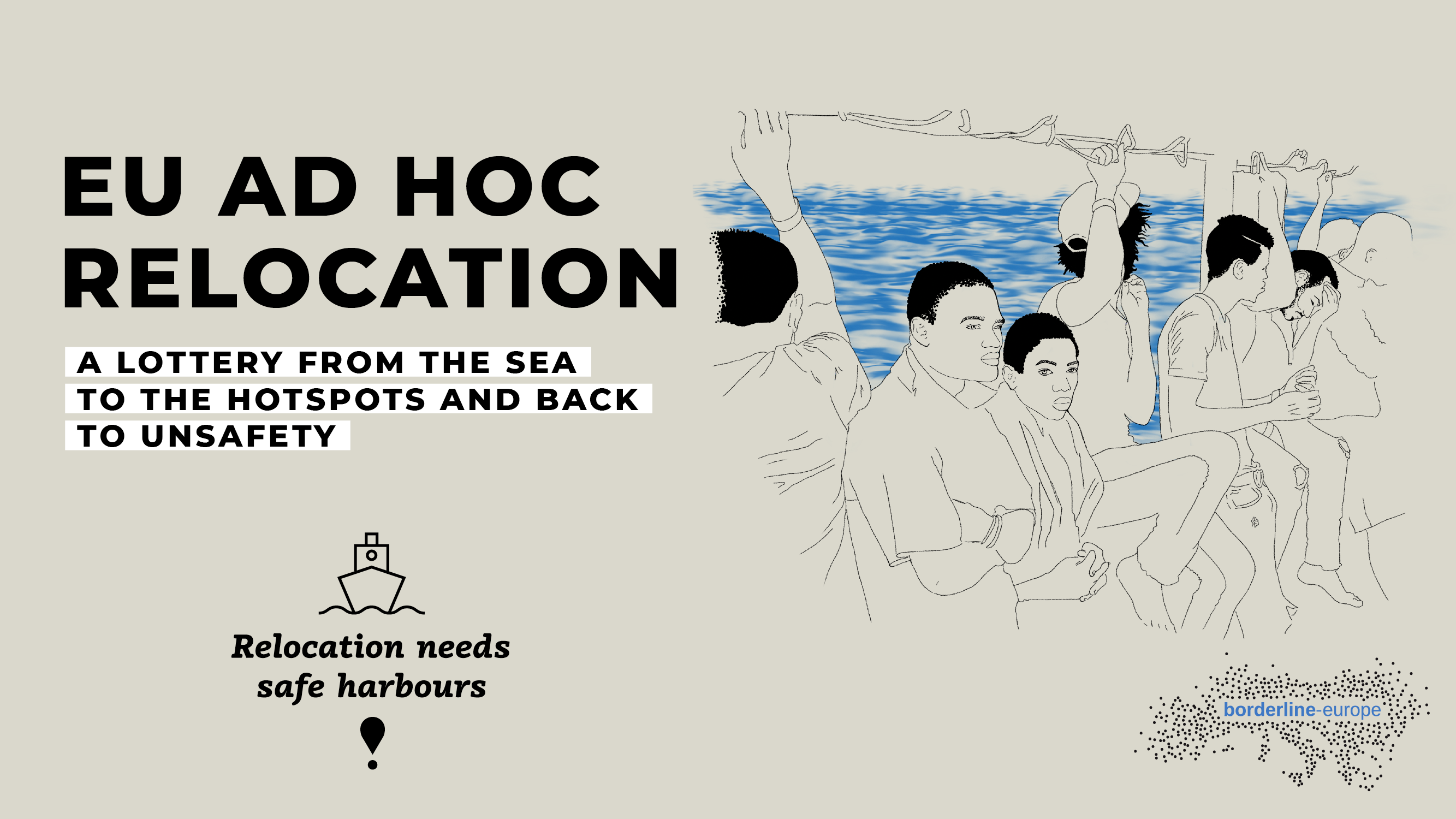
EU ad hoc relocation - A lottery from the sea to the hotspots and back to unsafety
Read the full report, watch the video statements made by the people rescued from distress at sea and relocated to Germany here:
Following attempts by the former Italian Ministry of the Interior to block the arrival of people rescued from distress at Sea in Italian ports between 2018 and 2019, an EU ad hoc distribution mechanism was adopted in Malta in September 2019. Search and Rescue vessels and people rescued at sea were not allowed to enter Italian and Maltese ports until other member states had agreed to accept them. Several persons rescued by the civil sea rescue vessels Sea-Watch 3 and Ocean Viking in Summer 2019 were to be distributed to Luxembourg, France, Finland, Portugal and Germany.
However, the states did not meet the agreed deadline of four weeks after which the people from the hotspots in Italy and Malta were to be relocated, nor did the methods used by the respective member states follow the common agreements or the rule of law. While France and Portugal only relocated people to whom they had granted protection status, Germany delayed the relocation process. After questionable security checks by the German Secret Service, whose responsibility in asylum procedures in other EU states is unclear, some persons were denied to be resettled without official justification. On top of that, several guests of Sea-Watch 3, Open Arms and Ocean Viking, who were finally resettled to Germany, received a rejection of their asylum claims through shortly after their arrival in Germany.
Together with Sea-Watch, Borderline Sicilia and the Refugee Council Berlin, we are investigating the arbitrary and non-transparent procedures of ad hoc relocation: from stand-offs off the EUropean coasts, to questionable security checks by the German Intelligence Service, to arrival in Germany.
Thanks to the support of the Foundation “Civil Sea Rescue Fund”, we are able to investigate to what extent fundamental rights have been violated in the course of ad hoc relocation. By conducting interviews in Italy and Germany, as well as a detailed background research on the criminalisation of the arriving persons by the German Intelligence Service in Malta and Italy, we will compile a detailed documentation. This will lay the foundation and serve as the starting point for a campaign for relocation and the right to stay, which will focus on the needs of people arriving in the EU.
In an online event in January 2022, affected individuals and other experts shared their perspectives on the EUropean relocation procedures. The event can be watched here.
Based on the insights gained from the project, we were able to extend our research to the Greek context in 2022 with the support of the Stiftungfonds Zivile Seenotrettung. In particular, we concentrated on the question: What happened to the people who were relocated after the fire in Moria? This resulted in the report: " Relocation from Greece to Germany: Relief for the Hotspot System or Alibi Policy?".