
Vom Meer ins Gefängnis (Jahresbericht 2025)
Die Kriminalisierung der sogenannten Schleuser im Jahr 2025
Projekt „Vom Meer ins Gefängnis“, jährlicher Bericht 2025
Im Jahr 2025 berichteten laut unserer Beobachtungen mehr als 250 Presseartikel über insgesamt 467 Festnahmen wegen „Beihilfe zur illegalen Einwanderung” gemäß Art. 12 des sogenannten „Einheitstextes zur Einwanderung“ (Testo Unico sull’immigrazione, kurz TUI). Es sei anzumerken, dass in diesem Kontext der Begriff „Festnahme” (it. „arresto“) nicht immer in seinem juristisch korrekten Sinn verwendet wird: In vielen Fällen bezieht er sich lediglich auf eine Anordnung zur Untersuchungshaft, gegen die die Verteidiger der Angeklagten Berufung einlegen können. In anderen Fällen bezieht sich derselbe Begriff auf Strafverfahren gegen nicht inhaftierte Personen, deren Aufenthaltsort unbekannt ist. Auch wenn aufgrund dieser weitgefassten Interpretation des Begriffs die obengenannte Zahl nicht der Anzahl der Personen, die sich tatsächlich im Gefängnis befinden, entspricht, kann uns ihre Betrachtung einen Eindruck davon vermitteln, wie sich die Kriminalisierung gemäß Art. 12 in den letzten Jahren entwickelt hat.
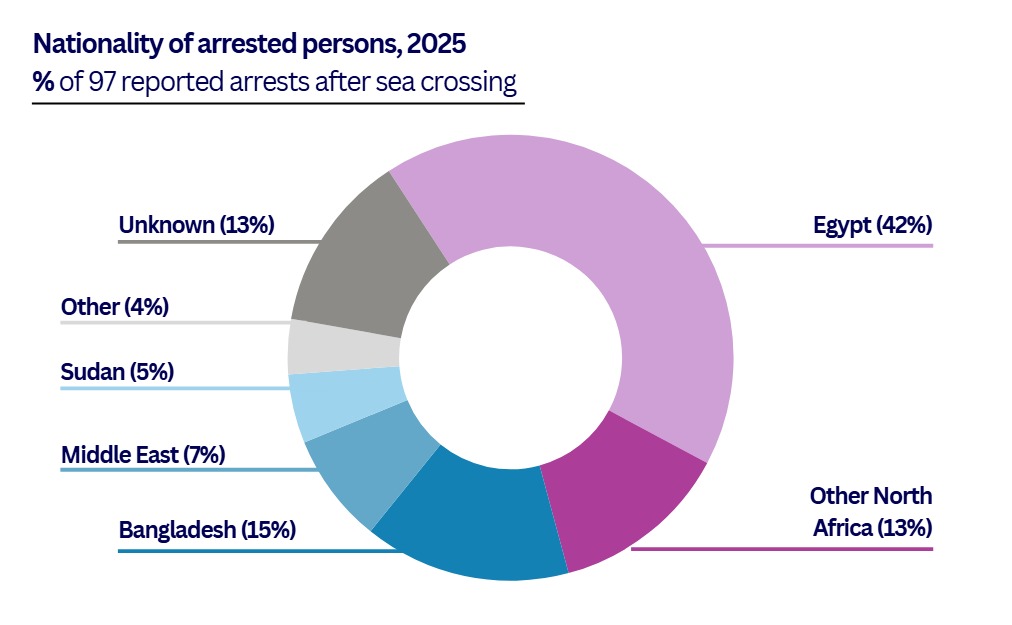
Nach Angaben der Vereinten Nationen sind im Jahr 2025 69.000 Menschen auf dem Seeweg nach Italien gekommen, von denen unserem Monitoring zufolge 97 Menschen unmittelbar nach ihrer Ankunft festgenommen wurden. Diese Häufigkeit entspricht etwa einer Festnahme pro 700 Ankünfte, ein leichter Rückgang im Vergleich zum Vorjahr (1 pro 600). Die am stärksten kriminalisierte Nationalität bleibt, wie auch in den letzten Jahren, die ägyptische, indem sie fast die Hälfte der Festnahmen ausmacht (41). Es folgen die Staatsangehörigen Bangladeschs (15 Personen), Tunesiens (7), Algeriens (5) und des Sudans (5). Weitere Festnahmen erfolgten von Menschen aus Eritrea, Iran, Irak, Libyen, Syrien, der Türkei und der Ukraine. Über die Staatsangehörigkeit von 13 Personen liegen uns keine Informationen vor.
Des Weiteren haben wir 76 Festnahmen an der Landgrenze gezählt, fast alle davon an der italienisch-slowenischen Grenze (68). Hier sind die Nationalitäten der festgenommenen Personen sehr unterschiedlich, vor allem stammen diese aus verschiedenen osteuropäischen Ländern, aber auch aus der Türkei, aus China und zahlreichen anderen Ländern. Wie aus der Recherche von Migreurop hervorgeht, haben die 2023 eingeführten Grenzkontrollen verstärkt zur Kriminalisierung, insbesondere von Personen aus Serbien geführt, allen voran von Autofahrer*innen in prekären Beschäftigungsverhältnissen, und somit mittelbar die Risiken und die Gefahren dieser Reise erhöht.
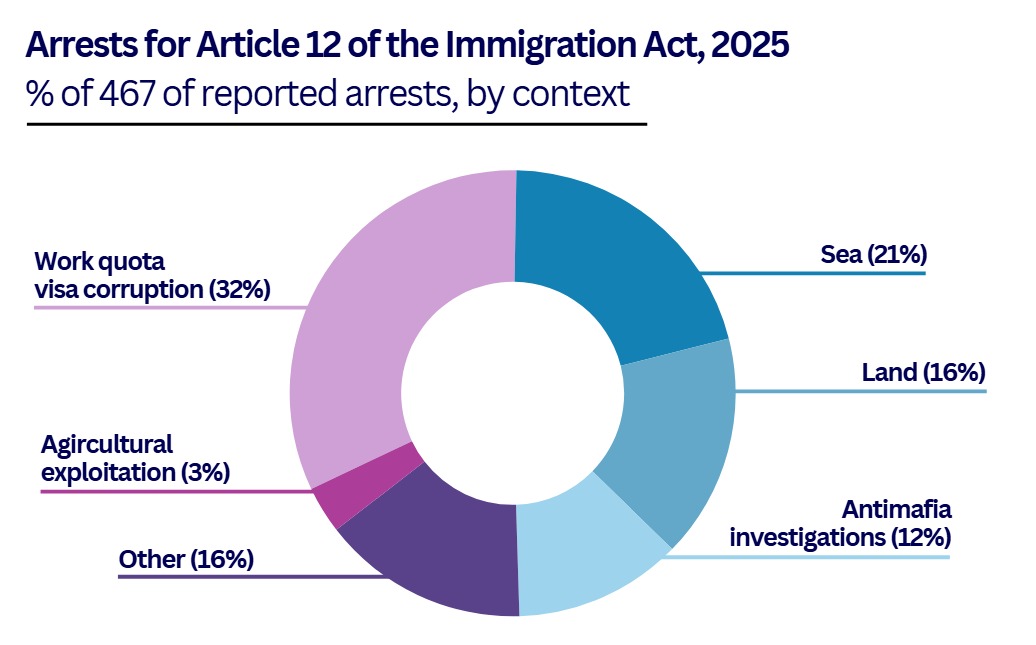
Etwa 300 Festnahmen wegen Beihilfe zur illegalen Einwanderung wurden hingegen in Fällen vorgenommen, an denen kein*e Kapitän*in oder Fahrer*in involviert war. Fast die Hälfte davon erfolgte wegen der Verwendung gefälschter Dokumente, um ein Visum über das Decreto Flussi (ein italienisches Regierungsdekret, das jährlich die maximale Anzahl von Nicht-EU-Ausländern festlegt, die aus Arbeitsgründen nach Italien einreisen dürfen, Anm. d. Übers.) zu erhalten. Im Mai 2024 veröffentlichte die Kampagne Ero Straniero Daten, die auf das strukturelle Scheitern des Dekretes hinweisen: Während sich die Regierung rühmte, reguläre Einreisewege eröffnet zu haben, stellte sie dieser positiven Rhetorik die Kriminalisierung der sogenannten Schleuser gegenüber. Effektiv gelangten 2024 und 2025 jedoch nur sehr wenige Menschen in diesem Kontext nach Italien, und noch weniger von ihnen erhielten eine Aufenthaltsgenehmigung.
Es ist bekannt, dass mit bestimmten, durch das Decreto Flussi begünstigten Dynamiken die Ausbeutung der Arbeitskraft und der Körper der betroffenen Menschen einhergeht. Dabei ist es ein Leichtes Ausbeutung und Betrug zum Opfer zu fallen, wenn man zu einer marginalisierten Gruppe gehört, und deswegen nicht über wichtige Grundrechte, die bspw. durch die Aufenthaltsgenehmigung zugestanden werden, verfügt. Diese Verhältnisse sind umso mehr zu beklagen, da sie strukturell sind: ein wichtiger Teil der italienischen Wirtschaft basiert auf dieser Prekarisierung der Arbeitsverhältnisse. Nichtsdestotrotz bekräftigen wir auch in diesem Fall, dass jede Person, die es schafft, die rassistisch gelenkte Grenzkontrolle zu überwinden, einen Sieg für alle darstellt und dass die Kriminalisierung derjenigen, die ihr Fortkommen erleichtern, – auch durch das Decreto Flussi – in erster Linie das Ziel hat, die Festung Europa zu stärken. Hätte der italienische Staat ernsthaft die Absicht gehabt, die nach Italien gekommenen Menschen zu schützen, hätte er mindestens versucht, ihnen gewisse Rechte zu garantieren, indem er sie etwa vor Ausbeutung am Arbeitsplatz schützt. Anstatt dessen werden diejenigen, die die Einreise dieser Menschen erleichtern, auf dramatisierende und exemplarische Weise kriminalisiert, wobei sich erneut auf Artikel 12 des TUI bezogen wird. Aus diesem Grund beobachten wir mit großer Sorge, mit welchem Elan die Regierung auch den missbräuchlichen Gebrauch von Einreiseanträgen der durch das Decreto Flussi festgelegten Arbeitsquoten kriminalisiert hat.
Darüber hinaus haben wir im Rahmen der Antimafia-Operationen (die von der DDA (Direzione Distrettuale Antimafia, deutsch: Bezirks-Antimafia-Staatsanwaltschaft) gegen Schleusernetzwerke durchgeführt wurde, eine bedeutende Anzahl vorläufiger Festnahmen (insgesamt 57 im Laufe des Jahres) verzeichnet, wobei die Operationen „Medusa” in Reggio Calabria und die Operation „El Rais” in Catania besonders hervorzuheben sind. Diese wohldurchdachten Operationen sind das Ergebnis jahrelanger Abhörmaßnahmen und Verhöre sowie einer zunehmend umfassenden Überwachungsstrategie, bei der Polizeikräfte verschiedener Länder systematisch zusammenarbeiten und von transnationalen Polizeibehörden unterstützt werden. Diese Dynamik spiegelt einen weitgreifenden Trend zum Datenaustausch und zum Einsatz von Überwachungstechnologien wider, die vor allem zur Bekämpfung des Schleusens eingesetzt werden. Dies hat beträchtliche negative Folgen auf die Freizügigkeit und auf den öffentlichen Raum im Allgemeinen, wie schon in der Vergangenheit festgestellt werden konnte.
Zuletzt möchten wir auch auf eine weitere Kategorie von Festnahmen hinweisen: die der caporali (16) (Arbeitsvermittler*innen, die auf illegale und ausbeuterische Weise Migrant*innen in sklavenähnliche Arbeitsverhältnisse vermitteln, Anm. d. Übers.). Die übrigen 70 Fälle sind von sehr unterschiedlicher Natur und umfassen Festnahmen wegen Sexarbeit, Scheinehen und der Beherbergung von Personen ohne Ausweispapiere (Art. 12, Absatz 5, wir haben zwei Fälle von Anklagen festgestellt, auch in diesem Fall gegen Nicht-Italiener).
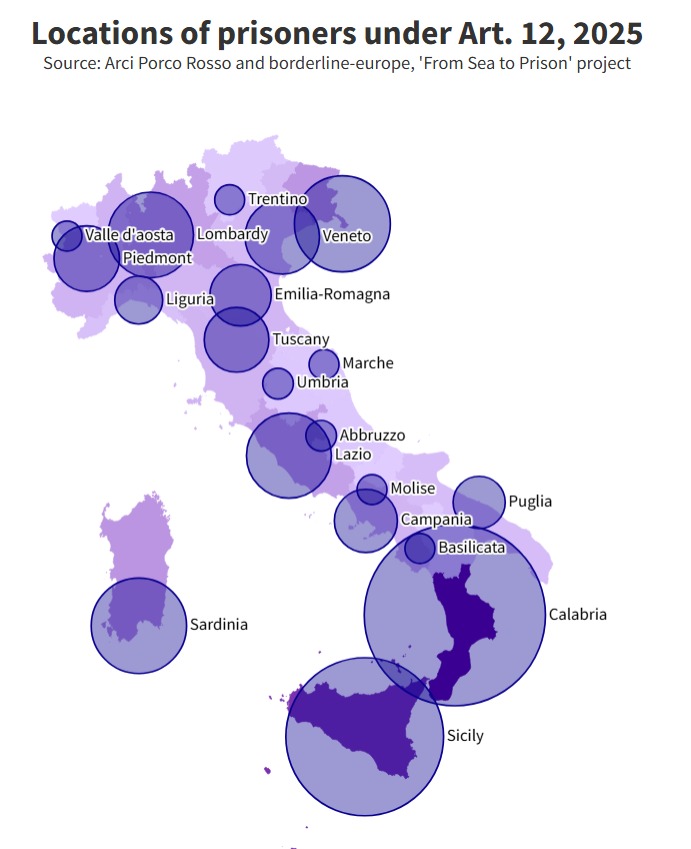
Zusätzlich zu den Daten, die aus unserem Monitoring hervorgehen, haben wir dieses Jahr auf offizielle Anfragen hin (FOIA) Zugang zu den Informationen bezüglich der Anzahl der Häftlinge italienweit, die wegen einer Straftat gemäß Art. 12 des TUI inhaftiert sind, erhalten.* Dabei hat sich herausgestellt, dass fast die Hälfte der 1167 Inhaftierten in kalabrischen und sizilianischen Haftanstalten untergebracht ist (27,5 % in Kalabrien und 21 % in Sizilien). 7 % befinden sich in Friaul, eine überraschende Zahl, die wir auf die zunehmende Kriminalisierung an der slowenischen Grenze zurückführen, von der wir bereits in Paragraphen zuvor berichtet haben. Die obige Karte vermittelt einen klaren Eindruck von der Verbreitung des Phänomens und macht einmal mehr deutlich, wie wichtig ein solidarisches Netzwerk ist, das den inhaftierten Menschen in ganz Italien zur Seite steht: Auch wenn dieses Problem vor allem den Süden betrifft, gibt es in Italien kein Gefängnis, in dem nicht jemand inhaftiert ist, der wegen Erleichterung der Freizügigkeit kriminalisiert worden wäre.
In Italien wie auch in anderen europäischen Ländern nimmt die Kriminalisierung von migrierenden Menschen vielfältige Formen an: so wird die Begünstigung der Bewegungsfreiheit bekämpft und die Solidaritätsbekundung gegenüber ausländischen Menschen und Räumen, die direkt oder indirekt von den freiheitsfeindlichen Maßnahmen der italienischen Regierung betroffen sind, strafrechtlich verfolgt.
In diesem Zusammenhang wird die Agenda der italienischen Regierung zur Bekämpfung der irregulären Migration immer umfangreicher. Es wird eine andauernde Notlage dargestellt, die die Einführung eines neuen Sicherheitspaketes 2026 rechtfertigen will, welches neben einer Reihe von Maßnahmen gegen diejenigen, die ihre Ablehnung gegenüber einer immer repressiveren Politik zum Ausdruck bringen, einen ganzen Abschnitt dem Thema Migration widmet. Zusätzlich zu einer Seeblockade für Rettungsschiffe umfasst der Entwurf des Sicherheitspaketes weitere Investitionen in die Vergrößerung der Inhaftierungsstrukturen für sogenannte irreguläre Personen auf italienischem Boden in Form von Aufenthaltszentren für die Rückführung ins Herkunftsland, den sogenannten CPRs (Centro di Permanenza per il rimpatrio), die einen wesentlichen Bestandteil in der Verfolgung der sogenannten Schleuser darstellen. Außerdem wird eine Verschlankung der Verfahren vorgeschlagen (d.h. Fälle, wie bspw. Asylanfragen, können nicht mehr mit ihren Eigenheiten und Besonderheiten betrachtet und dementsprechend bearbeitet werden, und teilweise könnte eine Beurteilung des fluchtursachenabhängigen Einzelfalles komplett wegfallen).
Dabei fungieren die Maßnahmen des Sicherheitspaketes als Kontinuum mit dem künftigen Inkrafttreten des EU-Pakts für Migration und Asyl im Juni 2026 und sind keineswegs zufällig entworfen worden: Der EU-Pakt zielt ebenfalls auf eine Ausweitung der Verwaltungshaft ab. Der geplante EU-Pakt, der aus einer Richtlinie und neun Verordnungen besteht, sieht neben einer verstärkten Zusammenarbeit zwischen den Mitgliedstaaten die Anwendung beschleunigter Asylverfahren auch für Familien und Minderjährige vor und, was entscheidend ist, eine zunehmend zentrale Legalisierung und Ausweitung von Verwaltungshaft. Gleichzeitig ist eine Reihe von Abkommen mit Drittländern vorgesehen, die auf europäischer Ebene als sicher gelten und darauf abzielen, die Abschieberegelungen auszuweiten und die dazu nötigen Haftzentren, sogenannte „hubs“, außerhalb der jeweils eigenen Landesgrenzen einzurichten.
In diesem Kontext wird über den Vorschlag diskutiert, den die Europäische Kommission dem Europäischen Parlament vorgelegt hat, die sogenannte „Facilitation Directive“, eine Richtlinie, die durch eine Reihe von Maßnahmen die Kriminalisierung von Personen, die die Freizügigkeit erleichtern, verschärft. Zu den wichtigsten Maßnahmen gehört die Stärkung von Europol, auch in finanzieller Hinsicht, durch die Konsolidierung des Europäischen Zentrums zur Bekämpfung der Migrantenschleusung, was künftig zu einer Erweiterung der Kapazitäten für den Austausch von Datenbanken und die Verarbeitung biometrischer Daten führen soll. Der Vorschlag zur Facilitation Directive wurde Ende 2023 übereilt und ohne echte Folgenabschätzung vorgelegt, was ungewöhnlich ist, insbesondere wenn man bedenkt, dass die Facilitation Directive strafrechtliche Bestimmungen einführt. Die Debatte im Europäischen Parlament zu diesem Thema, die unter anderem auf Druck der Zivilgesellschaft stattfand, konzentrierte sich auf die Tatbestandsmerkmale des Delikts „Schleusung”, das alle Mitgliedstaaten in ihrem nationalen Recht unter Strafe stellen müssen. Das Parlament, das voraussichtlich im Juli 2026 über den endgültigen Text abstimmen wird, ist dem Vorschlag der Kommission nicht gefolgt, auf das Erfordernis einer Gewinnabzielung zu verzichten und die Klausel zur Ausnahmeregelung für Personen, die aus humanitären Gründen handeln, einzuschränken. Ziel dieses Vorschlags war es, die Richtlinie an das UN-Protokoll gegen die Schleusung von Migrant*innen anzupassen, wobei das Risiko einer Erweiterung der Kriminalisierung nicht ausgeschlossen wird.
Die CPR scheinen mittlerweile die unvermeidliche Fortsetzung der Haftstrafe für die „Kapitän*innen“/„boat driver“ ** zu sein, wenn sie das Ende ihrer Strafe erreichen, selbst dann, wenn sie internationalen Schutz beantragt haben. Das administrative Etikett der Gesellschaftsgefährlichkeit (it. „pericolosità sociale“), das automatisch als Folge der Straftat vergeben wird, bringt die Aussicht auf eine Haft ohne bestimmbares Ende mit sich. Uns wurde berichtet, dass diese Aussicht auch privat und vom Personal im CPR von Caltanissetta kommuniziert wird, um Druck auf die Inhaftierten auszuüben, damit sie ein Dokument zum Verzicht auf Asyl unterschreiben und ihre Abschiebung akzeptieren.
Die CPR sind abscheuliche Nicht-Orte, deren bloße Existenz auf dem Gewissen dieser Regierung und dem ihrer Vorgänger lastet. In den letzten Monaten haben wir elf in CPRs festgehaltene Kapitän*innen in ihrem Kampf für Freiheit unterstützt. Drei von ihnen, die wir in früheren Berichten vorgestellt haben, wurden nach Ägypten abgeschoben. Mahammed Ezet wurde erst Anfang September freigelassen, obwohl er bereits seit Monaten Anspruch auf eine Aufenthaltsgenehmigung hatte. Jetzt arbeitet er in Italien, während er auf das Ergebnis seines Asylantrags wartet, und wir sind glücklicherweise noch in Kontakt. Auch die Person, die wir im CPR von Bari unterstützt haben (M., ägyptische Staatsangehörigkeit), wurde im Oktober endlich freigelassen und versucht nun, sich in einer Stadt in Norditalien ihr Leben wiederaufzubauen.
Leider besteht das Risiko, in ein CPR gebracht zu werden, für Ausländer*innen in Italien weiterhin fort, vor allem für diejenigen, die eine Zeit im Gefängnis verbracht haben. Derzeit unterstützen wir vier Personen – D., A., M. und L. –, die seit Monaten in den CPRs von Caltanissetta, Milo und Ponte Galeria inhaftiert sind, obwohl alle von ihnen bereits Asyl beantragt haben, und obwohl bei zwei ihnen eine Abschiebung gar nicht durchführbar ist, da sie aus Russland und dem Tschad stammen.
Derzeit begleiten wir die Fälle von 147 Personen, die als ‚Schleuser‘ angeklagt oder verurteilt wurden, und von denen etwa die Hälfte noch immer in Haft ist. Dank der unermüdlichen Arbeit von Anwälten, Netzwerken, Kollektiven, Vereinen und Künstlern, die sich in den letzten Jahren für eine Schärfung des allgemeinen Bewusstseins in Hinsicht auf eine Haft ohne ordentliches Gerichtsverfahren, die tausende Menschen bei ihrer Ankunft in Italien erwartet, eingesetzt haben, konnten wir in der zweiten Hälfte des Jahres 2025 wichtige juristische Erfolge verzeichnen.
Dies war der Fall bei vier Personen, die im Juli 2024 in Neapel festgenommen worden waren, drei Sudanesen und ein Tschader, die auf Antrag der Staatsanwaltschaft im vergangenen Dezember freigesprochen wurden. Der Freispruch erfolgte dank der Arbeit des Verteidigerteams, das den Notstand dieser Personen nachweisen konnte und damit den Schutz ihrer Leben auf der anderen Seite des Mittelmeers gegenüber der staatlichen Grenzkontrolle hat durchsetzen können.
Im Dezember begleiteten wir einen weiteren Antrag auf Freispruch, den Fall H., der nach einem fast zehnjährigen juristischen Leidensweg vom Berufungsgericht Palermo verhandelt wurde. Der Generalstaatsanwalt beantragte, H. freizusprechen, da dieser die Tat (Artikel 12 TUI: Beihilfe zur illegalen Einwanderung) nicht begangen hatte, und im Falle, dass dem Hauptantrag nicht stattgegeben würde, dass er angesichts eines Notstands gehandelt hatte. In seiner Anklagerede argumentierte er in Übereinstimmung mit dem Antrag der Verteidigung, dass die Identifizierung von H. als der Person, die das Boot gesteuert haben soll, unbegründet sei, da der einzige Zeuge, der angibt, ihn gesehen zu haben, nicht glaubwürdig ist. In jedem Fall hätte H. das Steuer des Bootes lediglich übernommen, um sich aus einer größeren Gefahr zu retten, dazu gehört die systematische Verletzung der Menschenrechte in Libyen. Wir erwarten die Entscheidung im März 2026.
Eine weitere positive Nachricht ist der Freispruch im Dezember 2025 für drei Angeklagte, Bürger aus Gambia, dem Sudan und Nigeria, die wegen des Vergehens in Art. 12bis vor dem Gericht von Agrigent angeklagt worden waren. Der Art. 12bis war mit dem Decreto Cutro eingeführt worden (2023 von Ministerpräsidentin Meloni nach dem Schiffsunglück bei Cutro erlassenes Dekret, das das Migrations- und Asylrecht verschärft; es erleichtert Abschiebungen und schränkt den humanitären Schutzstatus ein, Anm. d. Übers.). Erneut hat die Verteidigung die Unzulänglichkeit der Beweisaufnahme und die Unbegründetheit sowohl von Art. 12bis als auch allgemein von Art. 12 aufgezeigt. Einer der Angeklagten war bereits in der ersten Phase der ersten Instanz wegen Mangels an Beweisen aus der Untersuchungshaft entlassen worden, während die zwei anderen erst nach zwei Jahren vorläufiger Sicherungsmaßnahmen freigesprochen wurden. Einer der beiden wurde jedoch – obwohl seine Unschuld anerkannt worden war – im CPR von Milo festgehalten. Sein Asylantrag wurde nämlich als bloßes taktisches Mittel angesehen, da er nicht rechtzeitig im Gefängnis gestellt worden war. Diese Entscheidung berücksichtigt jedoch nicht die Hindernisse, denen eine inhaftierte Person beim Antrag auf internationalen Schutz begegnet. Nach mehr als einem Monat Haft wurde L. dank seiner Beharrlichkeit und dank der Arbeit seiner Anwältin und seiner Freunde endlich wieder auf freien Fuß gesetzt.
Obwohl diese Nachrichten Anlass zur Hoffnung geben, gibt es nach wie vor Situationen, in denen das Stigma, wegen einer Straftat gemäß Art. 12 verurteilt worden zu sein – selbst wenn die gesamte Strafe verbüßt wurde – zu weiteren Haftstrafen führen kann.
Dies ist der Fall von D. und E., russischer Staatsangehörigkeit, einem verheirateten Paar von Kriegsdienstverweigerern, die 2022 gemäß Art. 12 zu drei Jahren und sechs Monaten Haft verurteilt wurden. Die beiden hatten unmittelbar nach ihrer Ankunft in Italien internationalen Schutz beantragt. 2025, nach Ablauf ihrer Strafe, wurden sie als gefährliche Personen eingestuft und in CPR-Zentren überstellt, E. nach Rom und D. nach Trapani. Obwohl sie dieselbe Strafe erhalten hatten, wurde E. eine besondere Schutzform nach italienischem Migrationsrecht (it. „protezione speciale“) gewährt, weshalb sie nach einem Monat aus dem CPR-Zentrum entlassen wurde. Ihren Ehemann hingegen traf es anders: 2022 hatte ihm die Territoriale Kommission für die Anerkennung internationalen Schutzes (it. „commissione territoriale“) bereits während seiner Haft das Recht auf diese besondere Schutzform zuerkannt, und so beantragte D. nach zwei Jahren, als die Aufenthaltsgenehmigung ablief, erneut Asyl und verwies auf die große Gefahr, die ihn im Falle einer Rückkehr nach Russland erwartete. Er legte auch den Einberufungsbefehl vor, aber die zuständige Territoriale Kommission in Trapani hielt die Unterlagen für taktisch manipuliert und gefälscht und verlängerte somit seine Inhaftierung mit der Begründung der Gesellschaftsgefährlichkeit (it. „pericolosità sociale“). Auch der Versuch, die Beurteilung der Gesellschaftsgefährlichkeit durch das zuständige Überwachungsgericht neu bewerten zu lassen, führte nicht zur Freilassung von D.: Das Gericht zögerte hingegen diese Entscheidung bis zum Ablauf des eingelegten Widerspruchs bezüglich der Gewährung internationalen Schutzes hinaus. Währenddessen wartet E. in Palermo auf ihn, zwei Leben, die durch Krieg und Kriminalisierung miteinander verbunden und in der Schwebe sind. Europa findet immer Mittel für Waffen, aber nicht für diejenigen, die vor ihnen fliehen.
In diesem Jahr haben wir den Fall von Mouad weiterverfolgt, einem Jungen aus Guinea, der sich stets als minderjährig ausgegeben hat. Obwohl er Dokumente aus seinem Herkunftsland vorlegen konnte, die sein Alter belegen, wurden diese zunächst vom Berufungsgericht und anschließend vom Kassationsgericht als nicht entscheidend angesehen. Mouad wurde daher zu einer Freiheitsstrafe von drei Jahren und vier Monaten verurteilt. Glücklicherweise wurde Mouad jedoch dank der Aufnahme durch die Pfarrei Santa Lucia eine Minderung der Strafe in Form von Hausarrest gewährt. Wir haben ihn eng begleitet und ihn dabei unterstützt, Widerspruch gegen die Ablehnung des internationalen Schutzes einzulegen und es so gemeinsam geschafft, eine vorläufige Aufenthaltsgenehmigung vom Polizeipräsidium zu erhalten. Diese erfreulichen Entwicklungen wurden jedoch abrupt unterbrochen. An seinem vermeintlich letzten Tag im Hausarrest, wurde Mouad zurück ins Gefängnis gebracht, um dort die letzten zwei Monate seiner Strafe zu verbüßen: Der Überwachungsrichter hatte nachträglich die letzte Phase der vorzeitigen Entlassung abgelehnt und, als diese Entscheidung rechtskräftig wurde, die Strafminderung in Form von Hausarrest aufgehoben.
2025 kam es außerdem zu Gerichtsverfahren gegen drei iranische Staatsangehörige, die die Aufmerksamkeit der Medien und der Zivilgesellschaft auf sich zogen. Obwohl Italien offiziell seine Solidarität mit der regimekritischen Protestbewegung im Iran bekundet und die repressiven Reaktionen der iranischen Regierung verurteilt hatte, sah der italienische Staat keinen Widerspruch darin, Personen zu verhaften, die vor eben diesem Regime nach Europa geflohen waren: Maysoon Majidi, kurdisch-iranische Aktivistin und Regisseurin, Marjan Jamali und Babai Amir, Mitangeklagter der Letzteren. In diesem Jahr wurden sowohl Maysoon als auch Marjan nach intensiven Solidaritätskampagnen auf lokaler und nationaler Ebene freigesprochen. Maysoon ist nun Aktivistin in Italien und hat den Kampf gegen die Kriminalisierung in ihren Aktivismus für die Freiheit des kurdischen Volkes und für die Frauen im Iran integriert:
„Wie ich vor Gericht gesagt und in all den Monaten wiederholt habe: Wenn es auf diesem Boot Essen und Wasser gegeben hätte, hätte ich es aus humanitären Gründen verteilt. Warum sollte es ein Verbrechen sein, Menschen, die vor Krieg, Diktatur oder anderen Formen der Not fliehen, mit Wasser und Essen zu versorgen? Ich denke, dass Artikel 12 lediglich dazu dient, zwei bis drei Personen von jedem Boot, das in Italien ankommt, festzunehmen und sie als Schleuser anzuklagen. Die Situation ist fast schon zum Lachen und lässt keinen Raum für Worte.“
Im Juli 2025 legte die Staatsanwaltschaft Berufung gegen den Freispruch von Maysoon Majidi ein. Leider wurde Babai Amir, dessen Fall zwar sehr ähnlich war, aber weniger im Rampenlicht stand, zu sechs Jahren Haft verurteilt, woraufhin er versuchte, sich das Leben zu nehmen. Seitdem hat das lokale Netzwerk zusammen mit dem Kollektiv Oltre i Confini: Scafiste Tutte in Zusammenarbeit mit dem Anwalt daran gearbeitet, Hausarrest zu beantragen und eine Kampagne für die Freilassung von Amir zu starten. Der Verhandlungstermin steht noch aus. Wir können uns diesen Stimmen nur anschließen: Freiheit für Babai Amir!
Was die lange Leidenszeit der acht jungen Männer betrifft, die beschuldigt wurden, am 15. August 2015 ein Boot mit Flüchtenden gesteuert zu haben, und zu 20 und 30 Jahren Haft verurteilt wurden, so geht ihr Kampf weiter. In den letzten Monaten ist das Thema dank des Buches Perché ero ragazzo (dt. „Weil ich Junge war“), erschienen 2025 bei Sellerio, wieder in den Mittelpunkt der öffentlichen Debatte gerückt. Der Autor Alaa Faraj, einer der wegen Artikel 12bis verurteilten libyschen Fußballspieler, hatte nach seinen beiden Mitangeklagten einen Antrag auf Revision gestellt, der vom Kassationsgericht so wie die beiden anderen ebenfalls für unzulässig erklärt worden war. Auf Anraten des Gerichts selbst beantragte Alaa eine Begnadigung, die ihm Präsident Mattarella im Dezember 2025 als Teilbegnadigung gewährte, was seiner allgemeinen Zurückhaltung in Bezug auf diese Maßnahme entspricht.*** Es bedurfte also auch der Intervention des Staatsoberhauptes, um erneut zu bekräftigen, dass Alaa trotz allem im Gefängnis bleiben wird, auch wenn er bereits in diesem Jahr (2026) Zugang zu alternativen Maßnahmen zur Gefängnisstrafe erhalten kann. Seine Mitangeklagten, die seine Geschichte teilen, müssen im Gefängnis bleiben, da sie weder politisch noch rechtlich von der Begnadigung betroffen sind. Freiheit für Alaa, Freiheit für Tarek, Mohamed, Ayoob, Abdelrahman, Mustafa, Mohanned und Beddat!
 |
In diesem Jahr konnten wir Fortschritte beim Aufbau eines nationalen und transnationalen Netzwerks verzeichnen, das die Kriminalisierung von Kapitän*innen kritisch anprangert und wichtige Kampagnen für die Freiheit inhaftierter Personen durchführt. Zentrale Beispiele sind die Kampagnen für den Freispruch von Maysoon Majidi und die Teilbegnadigung Alaa Faraj, über die wir oben berichtet haben und die beide von bedeutenden Erfolgen geprägt waren. Maysoon beteiligte sich online an den Podiumsdiskussionen, die wir im September 2025 im Rahmen des Festival Sabir organisierten, zusammen mit den Ragazzi Bayefall, Maldusa, Associazione Gambiana di Palermo, De:Criminalize, Refugee Platform in Egypt, Mataris, 50 Out of Many, Migreurop und Projecto Patrones.
Angesichts der bevorstehenden Umsetzung des EU-Pakts für Migration und Asyl im Juni 2026 würdigen wir den außergewöhnlichen Beitrag der Europaabgeordneten Ilaria Salis im November 2025, die auf die semantische Verwirrung zwischen Menschenhandel (it. „tratta“), Menschenhandel (it. „traffico“) und Schleusern (it. „smuggler“) hingewiesen hat – eine Verwirrung, die von der EU instrumentalisiert wird, um im Namen der Sicherheit an ihren Grenzen wissentlich Menschen zu Tode kommen zu lassen. Da Salis daran erinnerte, dass es kein Vergehen sein sollte, Menschen bei der Flucht vor Krieg und Verfolgung zu helfen, wurde sie von der italienischen und europäischen rechten Presse angegriffen. Salis hat sich exponiert, um in einer Zeit, in der dies immer seltener wird, integer zu bleiben, und wir bekunden unsere Solidarität und Verbundenheit angesichts der anhaltenden Angriffe.
In dem Klima des Krieges und des rassistischen Hasses, das uns umgibt, ist es ein Leichtes, dem Pessimismus zu verfallen und das Gefühl zu haben, dass alles verloren sei. Doch die klaren und kraftvollen Worte von Maysoon, Alaa und vielen anderen kriminalisierten Menschen sowie die Entschlossenheit von Aktivist*innen und Politiker*innen, die sich offen zur Solidarität bekennen, erinnern uns daran, dass aufgeben keine Option ist und dass es unsere gemeinsame Verantwortung ist, weiter für Gerechtigkeit zu kämpfen. In Ragusa wird der Prozess gegen die Besatzung der Mediterranea fortgesetzt, die wegen desselben sogenannten Vergehens angeklagt ist, das in den letzten 25 Jahren dazu benutzt wurde, tausende von Menschen zu unterdrücken, zu inhaftieren und zu bestrafen. In Crotone hingegen dauert der Prozess gegen einige der Personen, die beschuldigt werden, das 2023 in Cutro gekenterte Schiff gesteuert zu haben weiterhin an – parallel zu dem Prozess gegen die Polizeibeamten, denen vorgeworfen wird, mehr als 100 Menschen im Meer zurückgelassen und damit faktisch zum Tode verurteilt zu haben. An Land und auf See werden wir also auch 2026 weiterhin gegen Faschismus, Rassismus und die weiße Vorherrschaft kämpfen und für eine Welt, in der unsere gemeinsame Menschlichkeit Vorrang vor menschenfeindlicher Grenzpolitik und vor weiteren Spaltungen hat.
„Vom Meer ins Gefängnis“
Vom Meer ins Gefängnis ist ein militantes Projekt von Arci Porco Rosso und borderline-europe, das seit 2021 die Kriminalisierung der sogenannten Schleuser in Italien verfolgen. Wir bieten den kriminalisierten Personen sozial-juristischen Beistand. Ein herzliches Dankeschön an Guerilla Foundation, FGHR, Sea Watch, Safe Passage und United4Rescue, die sich dafür entschieden haben, dieses Vorhaben und unsere Militanz zu unterstützen. Außerdem danken wir Maghweb für das Coverfoto.
* Wir danken Giulia Serio, Forscherin an der Universität Palermo und Aktivistin des Arci Porco Rosso für ihre Recherchearbeit, die diesem Abschnitt zu Grunde liegt.
** Personen, die wegen Beförderung (über das Meer) von illegalisierten Personen angeklagt sind.
*** Während seiner Amtszeit hat Präsident Mattarella insgesamt 27 Gnadengesuche bewilligt und 1020 abgelehnt. Gemeinsam mit Präsident Napolitano (2006-2015) sind dies die wenigsten Bewilligungen von Gnadengesuchen in der gesamten jüngeren Geschichte der Republik.
Arci Porco Rosso, Februar 2026
Danke an Sarah Tobor für die Übersetzung ins Deutsche.